
With Microsoft’s release of the M365 G7 license, it is easy to view the offering as simply Microsoft 365 G5 and adding Copilot. However, that impression understates G7’s additional capabilities and strategic value. The G7 license combines enterprise AI and AI-agent management with expanded cybersecurity capabilities for identity, governance, and secure access. For eligible Government Community Cloud (GCC) customers, these capabilities will become available in phases, so agencies should confirm workload availability and purchasing options with Microsoft or their licensing partner. As capabilities become available, agencies can assess opportunities to reduce overlapping third-party investments.
M365 G7 Expands the Value of the End-User Platform
M365 G5 already provides a strong foundation for productivity, communications, cybersecurity, identity, and compliance. M365 G7 extends that foundation with three key additions:
- Microsoft 365 Copilot: Delivers enterprise AI directly into the applications employees already use, helping improve productivity, accelerate analysis, and transform how work gets done.
- Agent 365: Provides a unified control plane to discover, observe, govern, secure, and manage a rapidly growing population of AI agents.
- Microsoft Entra Suite: Extends Microsoft’s identity capabilities beyond authentication to include identity governance, private application access, and secure internet access. The Entra Suite may be the least considered, but potentially it is one of the most essential elements of the business case for upgrading to the G7.
Can the M365 G7 License Save Money by Reducing Third-Party Security Investments?
Over the past several years, government agencies have invested significantly in Zero Trust, secure network access, and identity governance. Many purchased third-party solutions because comparable capabilities were not available through the Microsoft enterprise platform. Although M365 G5 included Microsoft Entra ID P2 capabilities such as Identity Protection and Privileged Identity Management, it did not include the full Microsoft Entra Suite. M365 G7 changes that equation by adding Entra Suite capabilities, subject to GCC workload availability and agency requirements.
- Entra ID Governance creates an opportunity to evaluate overlap with SailPoint, Saviynt, Okta Identity Governance, Oracle Identity Governance, One Identity, IBM Security Verify Governance, and equivalent products.
- Entra Private Access creates an opportunity to evaluate duplicative services provided by Zscaler Private Access, iboss ZTNA, Netskope Private Access, Palo Alto Prisma Access, Cisco Secure Access, Cloudflare Access, Appgate, Twingate, and VPN replacement solutions.
- Entra Internet Access creates an opportunity to evaluate the need for overlapping services with Zscaler Internet Access, iboss, Netskope, Palo Alto Prisma Access, Cisco Secure Access/Umbrella, Cloudflare One, and other Secure Web Gateway or Security Service Edge solutions.
The capabilities included in M365 G7 do not automatically justify retiring third-party products. Some products may provide specialized capabilities, integrations, performance, coverage, or authorization status that an agency still requires. CIOs should conduct capability-level cost, security, compliance, and operational assessments before reducing or replacing third-party licenses.
The Opportunity Is Bigger Than License Savings
During my time as a federal CIO, I continually balanced the need to protect the enterprise against cyber threats with the funding available for those protections. One lesson was constant: there was never enough funding to pay for two, three, or more solutions that performed the same function. Reducing redundant products can lower software costs, but the greater impact may come from simplifying the enterprise technology footprint. Every additional enterprise product brings another contract, technical configuration, and ongoing management and support burden—including patching and upgrades, maintenance costs, and staff training and expertise.
For organizations already invested in Microsoft 365, the M365 G7 license creates an opportunity to bring more identity, security, access, and governance capabilities into an integrated platform. Potential outcomes include fewer products and vendors, lower support costs, less operational complexity, simpler and more consistent policies, and fewer gaps among independently managed security tools. Actual savings and operational benefits will vary by environment and should be validated through an agency-specific assessment.
And Then There Is the Army of AI Agents
AI agents will increasingly perform work alongside employees, creating a new population of “users” that government organizations must discover, secure, monitor, and govern. We recently published G7 in GCC and the Lifecycle of Governed AI Agents, which explores this need in greater detail.
The executive takeaway is straightforward: the AI workforce requires governance, just as the human workforce does. Agent 365 provides a control plane for discovering, managing, governing, and securing agents, while the Entra Suite provides identity and access capabilities for users and supported agent scenarios.
- Copilot empowers the workforce.
- Agent 365 governs the agent workforce.
- Entra controls and governs access across the enterprise.
Evaluate M365 G7 as an Enterprise Platform Decision, Not Just an Upgrade
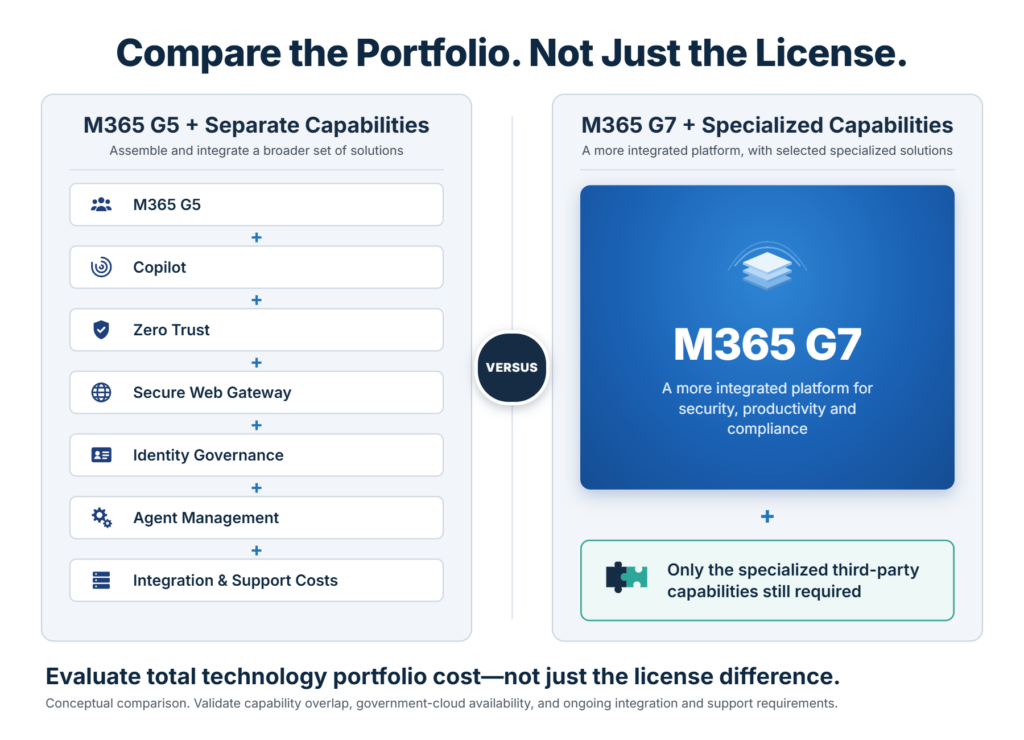 Government agencies should not evaluate M365 G7 against M365 G5 plus Copilot solely on Microsoft’s incremental license price. The business case should account for the total cost and value of the technology portfolio, including implementation, migration, operations, support, training, security, compliance, and any third-party products that could be reduced or retired.
Before renewing major enterprise licenses for Zscaler, iboss, Netskope, Palo Alto, SailPoint, or similar products, CIOs should evaluate whether M365 G7 can consolidate any of that functionality without compromising mission, security, performance, integration, or compliance requirements. The central question should not be, “How much more does G7 cost?” It should be, “What will our total technology portfolio cost after we fully use the M365 G7 capabilities available to our organization?”
How Planet Can Help
Planet can identify and map an agency’s existing Microsoft, identity, Zero Trust, and third-party security investments against M365 G7 capabilities. This assessment can help determine which products should remain, where licenses or modules may be reduced, and where duplicative investments may be consolidated or eliminated. We can also help implement a limited pilot so agencies can test assumptions and validate outcomes before an enterprise deployment.
Combined with the agent-governance approach outlined in our recent M365 G7 article, this work provides an executive-level roadmap for evaluating M365 G7 based on business value, security outcomes, and technology consolidation—not licensing cost alone.
M365 G7 is not simply M365 G5 + Copilot. It is an opportunity to reassess the technology stack required to operate, secure, and govern an AI-enabled enterprise.
About the Author
Guy Cavallo, Chief Innovation Officer, Planet Technologies
Guy Cavallo is an award-winning technology transformation leader with a distinguished career in both public and private sectors. Recognized for driving innovation in government IT, he has received numerous accolades, including the prestigious Distinguished Presidential Rank Award, multiple Federal 100 and FedScoop 50 awards, and recognition as a top government IT leader. A successful entrepreneur and industry thought leader, he has been featured in publications and contributed to major IT modernization efforts on a national scale. LinkedIn
Learn More
- Unleash the Power of Your Microsoft Investment
- G7 in GCC and the Lifecycle of Governed AI Agents
- Microsoft 365 Training with Evolve 365
- Microsoft Expertise
- Microsoft Accelerators
Something else or not sure where to start? Email us at [email protected]