
Dive into the tectonic shift defining America’s technological future with the release of the March 2026 National Policy Framework for Artificial Intelligence.
The crisis of potential regulatory fragmentation—threatened by a chaotic patchwork of fifty discordant state laws—is being replaced by a unified, pro-innovation legislative blueprint. This reality demands that organizations move beyond compliance anxiety and embrace a minimally burdensome national standard designed to accelerate deployment, remove bureaucratic barriers, and solidify global AI leadership.
An Innovation-First Approach
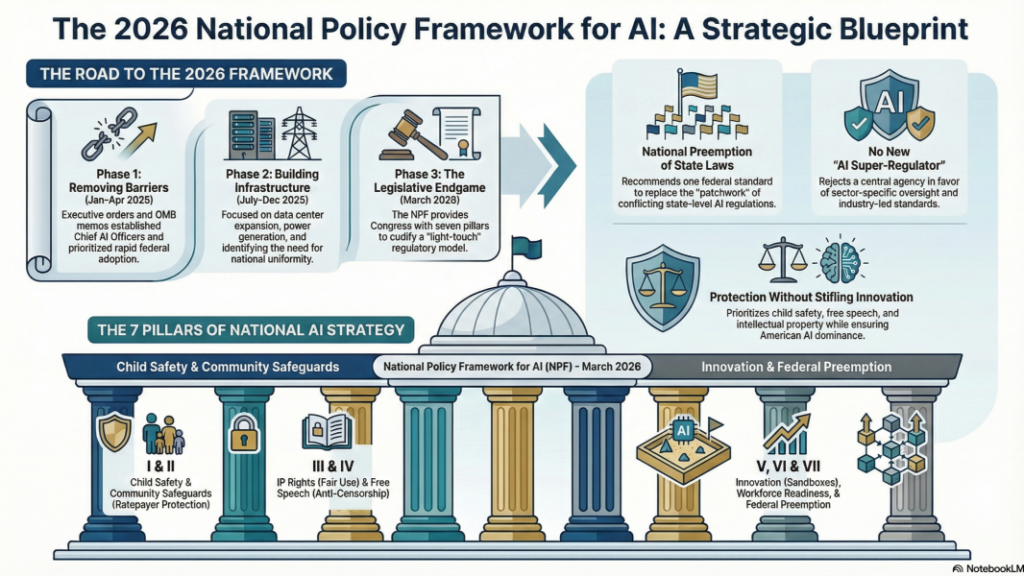
The modern AI strategy is defined by an “innovation first” approach: explicitly rejecting the creation of a new, overarching federal AI super-regulator in favor of relying on existing, sector-specific agencies.
This framework balances rapid capability scaling—through regulatory sandboxes and streamlined infrastructure permitting—with non-negotiable guardrails, including the Ratepayer Protection Pledge to shield residential consumers from data center electricity costs, and strong privacy protections for children.
The Seven Pillars Shaping the AI Policy Landscape
The framework introduces a clear structure for navigating AI policy, built around seven primary legislative pillars:
1. The Preemption Pivot
Managing the transition to a single national standard that preempts cumbersome state laws on AI development—providing regulatory certainty to invest and scale nationally while respecting local zoning and police powers.
2. The Child Safety Mandate
Implementing commercially reasonable, privacy-protective age assurance requirements and robust parental controls to protect minors without introducing ambiguity that could slow innovation.
3. Infrastructure & Community Safeguards
Capitalizing on streamlined federal permitting for AI data centers and behind-the-meter power generation, while ensuring residential consumers are not burdened with increased electricity costs.
4. The Pragmatic IP Approach
Navigating collective licensing frameworks and digital replica protections, while allowing courts—not rushed legislation—to resolve copyright “fair use” questions related to AI model training.
5. Free Speech Guardrails
Establishing clear prohibitions against government coercion of AI providers to suppress lawful political expression or dissent.
6. The Innovation Accelerator
Enabling safe experimentation through regulatory sandboxes and expanded access to federal datasets in AI-ready formats—all under existing agency oversight.
7. The Human Capital Strategy
Integrating AI training into land-grant institutions and apprenticeship programs to support workforce adaptation as AI reshapes how work gets done.
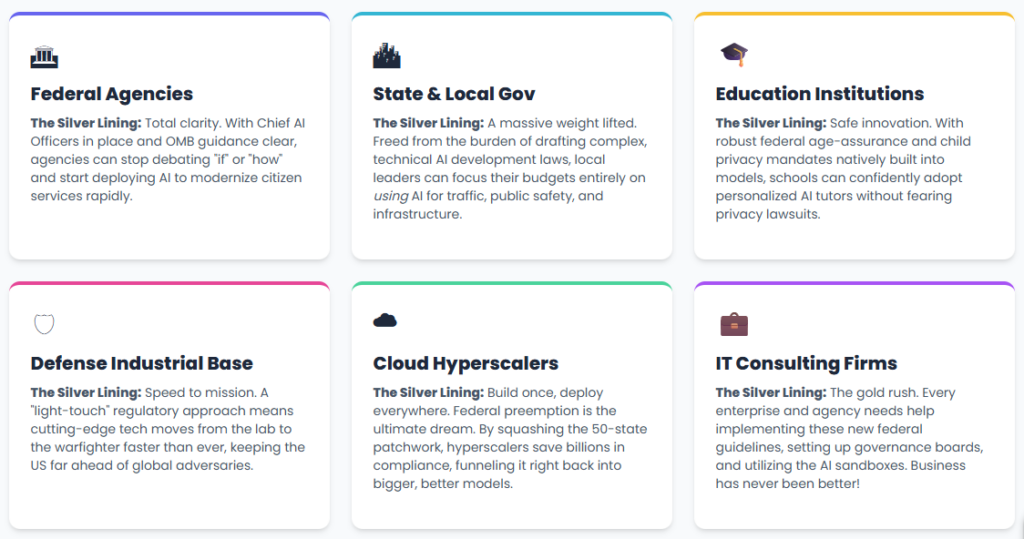
The Silver Lining
What this framework ultimately represents is a shift in posture.
Instead of regulatory uncertainty slowing progress, organizations now have a clearer path forward—one that prioritizes innovation, reduces friction, and provides the structure needed to move with confidence.
Contact Planet Technologies at [email protected] for guidance on navigating AI policy, adoption, and readiness.